15 Seamless Grid Patterns
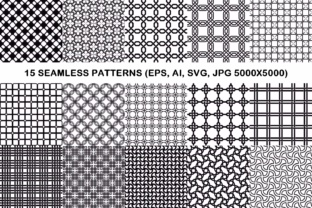
The 15 Seamless Grid Patterns package is a curated digital asset collection designed for designers, developers, and print professionals seeking versatile, high-fidelity grid-based background elements. It includes 15 distinct vector patterns—each engineered to tile infinitely without visible seams—delivered in four widely compatible formats: AI (Adobe Illustrator), EPS (Encapsulated PostScript), SVG (Scalable Vector Graphics), and JPG (5000×5000 pixels, RGB or grayscale). All patterns are monochrome, emphasizing structural clarity through black-and-white contrast, and draw from recurring motifs such as lattice, trellis, round joint, fence-like arrangements, and geometric interlocking forms.
These patterns serve functional and aesthetic roles across disciplines. In web design, SVG variants integrate cleanly into CSS backgrounds or inline markup, supporting responsive layouts without pixelation. In branding and editorial work, the AI and EPS files allow precise scaling for stationery, packaging, or large-format prints. The JPGs offer immediate usability in photo editing software or presentation tools where vector support is limited.
One reason designers consider the 15 Seamless Grid Patterns package is consistency of quality and format coverage. Unlike single-format downloads or low-resolution raster packs, this set delivers production-ready assets across industry-standard vector and bitmap workflows. Each pattern is built with uniform tiling logic, ensuring predictable repetition whether applied to a business card or a billboard. The monochrome constraint also supports accessibility and flexibility: users can recolor vectors non-destructively or overlay them on varied base tones without hue interference.
A key benefit lies in time efficiency. Manually constructing seamless grids—especially those with precise alignment, balanced negative space, and scalable geometry—requires advanced vector skills and iterative testing. With this package, users bypass that learning curve and implementation overhead. For example, creating a subtle trellis texture for a luxury brand’s website background or a structured lattice for fabric print development becomes a matter of selection and application—not hours of anchor-point adjustment and tile boundary refinement.
However, tradeoffs exist. Because all patterns are strictly monochrome and grid-based, the package does not accommodate color gradients, organic shapes, photographic textures, or irregular layouts. Users needing chromatic variation must apply fills or filters post-import—a step requiring familiarity with their design software. Similarly, while the patterns are described as “round,” “joint,” or “fence”-inspired, these terms reflect structural analogies rather than literal representations; expectations of photorealism or illustrative detail should be adjusted accordingly.
Another consideration is scalability versus specificity. Vector formats scale infinitely, but the underlying design language remains intentionally restrained: geometric, systematic, and minimal. That makes the 15 Seamless Grid Patterns well-suited for modernist interfaces, architectural visualizations, technical documentation, or typography-forward layouts—but less ideal for playful, hand-drawn, or highly decorative contexts. If your project calls for asymmetry, soft edges, or contextual storytelling (e.g., a botanical grid mimicking vine growth), alternative pattern libraries with more stylistic range may better align with your goals.
Compatibility is generally strong, but verification remains prudent. While SVG files work reliably in modern browsers and design tools, older versions of some software may render certain vector effects inconsistently—particularly if strokes are defined using complex blending modes or transparency layers not present in this pack, but worth confirming against your target environment. Likewise, the 5000×5000 JPGs provide ample resolution for most print and screen uses, yet users working at extreme scales (e.g., panoramic wall murals) may need to verify pixel density requirements against output specifications.
The 15 Seamless Grid Patterns package fits most strongly when clarity, reproducibility, and neutrality are priorities. Consider it for corporate identity systems requiring subtle background textures, UI kits needing consistent dividers or section separators, textile prototyping where repeat structure dictates fabric behavior, or educational materials illustrating symmetry, tessellation, or modular design principles. Its strength is in reliability—not novelty.
Conversely, alternatives merit evaluation in several scenarios. If you require editable color palettes out-of-the-box, look for multi-color pattern bundles with swatch-integrated AI files. If responsiveness includes dynamic recoloring via CSS custom properties, SVGs with semantic fill attributes (rather than flat paths) may offer greater control. For motion design or interactive applications, animated SVG patterns—or procedural generation tools—could provide more adaptability than static assets. And if licensing scope matters (e.g., for client deliverables or SaaS platforms), confirm usage rights explicitly, as license terms vary between vendors and are not inherent to the file types themselves.
Practical decision-making starts with use-case mapping. Ask: Will this pattern appear at multiple scales? Then prioritize vector formats. Is it destined for print? Confirm CMYK readiness—note that this package delivers RGB JPGs and device-independent vectors, so conversion may be needed for offset printing. Does your team use Figma or Sketch? SVG imports are supported, but AI/EPS files may require intermediate export steps. Are patterns needed in bulk across dozens of projects? The fixed count of 15 offers breadth within its niche but isn’t exhaustive—compare against subscription-based services if long-term variety outweighs one-time cost efficiency.
Also consider workflow integration. Designers embedded in Adobe Creative Cloud benefit directly from native AI and EPS support. Developers integrating into frontend code gain from lightweight, accessible SVGs with clean markup. Those relying on open-source tools like Inkscape or GIMP will find SVG and JPG files fully usable, though AI/EPS may require conversion. No format in the 15 Seamless Grid Patterns set requires proprietary plugins or cloud dependencies—making it suitable for offline or regulated environments.
Finally, assess expectation alignment. This is not a generative toolkit, nor does it include tutorials, style guides, or usage examples. It assumes foundational knowledge of pattern application—such as defining artboards for repeats, setting up CSS background-repeat rules, or adjusting SVG viewBox attributes. Users new to seamless tiling may benefit from supplemental resources on tile boundaries and offset alignment before deploying these assets at scale.
In summary, the 15 Seamless Grid Patterns package delivers focused, technically sound assets for practitioners who value precision, format versatility, and monochromatic versatility. It excels where structural integrity and cross-platform compatibility matter more than stylistic flamboyance. Evaluating it alongside your specific output requirements, software ecosystem, and long-term design system needs—not just visual preference—leads to more grounded, sustainable choices.