15 Seamless Wave Line Patterns
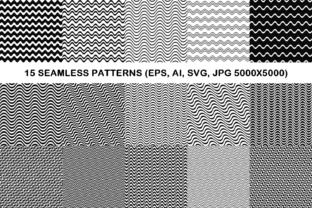
If you’ve ever spent 20 minutes searching for a clean, scalable wavy background that doesn’t tile awkwardly—or worse, pixelates when enlarged—you know how much time a well-made pattern can save. 15 Seamless Wave Line Patterns is a practical, no-fuss collection built for people who need rhythm, flow, and visual calm without the design overhead. It’s not abstract art or experimental glitch texture—it’s functional wave-based geometry: soft curves, consistent spacing, monochrome precision, and true seamlessness across all 15 variations.
Each pattern is crafted to repeat invisibly in any direction—no visible joins, no distortion at edges, no guesswork when tiling across banners, slides, or large-format prints. And because it comes in four native formats—vector AI, EPS, and SVG plus high-res JPG (5000×5000)—you’re covered whether you’re editing in Illustrator, prepping for a Cricut cut, embedding in a web page, or exporting for print-on-demand.
Where these wave line patterns actually get used—every day
Designers aren’t the only ones reaching for wave motifs. Think about where gentle motion and organic flow matter: a teacher creating a calming classroom slide deck; a wellness coach designing a meditation guide; a small-batch candle maker needing subtle texture behind product photos; or a blogger building a serene “slow living” newsletter template. These aren’t edge cases—they’re everyday needs met by 15 Seamless Wave Line Patterns.
A freelance graphic designer told us she uses one of the tighter stripe variants as a subtle divider between sections in client pitch decks—“It adds movement without competing with text.” Another user—a university lecturer—applies a softer, wider wave as a low-contrast background for lecture handouts. “Students don’t get distracted,” she said, “but it feels more intentional than plain white.”
Even non-designers find value. A Shopify store owner uses the black-and-white wave patterns as overlays on lifestyle product images—softening harsh lighting while keeping focus on the item. No Photoshop skills required: just drag the SVG into Canva, adjust opacity to 8–12%, and export. The result? Cohesive, brand-aligned visuals that take under two minutes to produce.
Real use cases—by role and context
- Bloggers & content creators: Use the wavy line backgrounds as full-width section dividers in WordPress themes or Notion pages—especially effective in “about,” “services,” or “testimonials” blocks where visual breathing room matters.
- Educators & trainers: Print the JPG versions at actual size (5000×5000) onto A3 paper for tactile learning tools—think wave-patterned worksheets for rhythm exercises in music class or visual anchors for mindfulness prompts.
- Small business owners: Apply a medium-wave pattern as a watermark on digital invoices, proposal PDFs, or downloadable checklists—subtle enough to avoid clutter, distinctive enough to reinforce brand tone.
- Marketers & social managers: Layer a thin, high-contrast wave line over muted stock photos for Instagram carousels or LinkedIn banners—adds motion and cohesion without requiring custom illustration.
- Hobbyists & makers: Import the SVG files directly into Silhouette Studio or Cricut Design Space to cut wave-shaped borders on greeting cards, vinyl decals, or fabric stencils—scalable to any size, zero loss of fidelity.
Why monochrome—and why “seamless”—actually matter
Color limits flexibility. A blue wave pattern may clash with your brand palette. A gradient version might not convert cleanly to grayscale for printing. That’s why 15 Seamless Wave Line Patterns sticks strictly to black and white: maximum adaptability. You can recolor any vector file in seconds, invert it for dark-mode interfaces, or apply duotone effects in Figma without breaking the lines.
“Seamless” isn’t just marketing language here—it’s measurable. Each pattern was tested by tiling across a 10×10 grid in Illustrator, zoomed to 400%, then visually inspected for alignment drift, stroke weight inconsistencies, or anchor point artifacts. What you download works—not “almost works” or “works if you tweak it first.”
What to consider before using them
Not every wave pattern suits every purpose. A tight, high-frequency line works beautifully as a subtle texture behind body text—but would overwhelm a hero banner. A wide, slow undulation reads clearly on a 24” monitor but may vanish entirely in a mobile thumbnail. Before dropping one in, ask:
- What’s the viewing context? Will this be seen on screen, printed, stitched, or projected? SVG and vector formats shine for scalability; JPG gives reliable color fidelity for photo composites.
- What’s the visual hierarchy? If your content relies on clarity—like accessibility-focused materials or data dashboards—opt for lower-contrast waves or lighter stroke weights.
- How much repetition is appropriate? Some patterns read as “stripes” up close but resolve into fluid motion at arm’s length. Test at actual usage size—not just in your design app.
Also worth noting: these are line-based, not filled. That means they work equally well as positive space (black lines on white), negative space (white lines on black), or transparent overlays. No clipping masks needed—just layer, adjust fill/stroke, and go.
From sea to screen—and beyond
The inspiration is obvious—ocean swells, water ripples, wind-swept sand—but the utility is grounded in real workflows. A wedding planner uses one of the gentler curves as a border on digital RSVP cards. A physical therapist imports the SVG into a patient education handout to illustrate breathing rhythm (“inhale = rise, exhale = fall”). A podcast host drops a wave line behind episode cover art to imply continuity and flow across seasons.
None of these require advanced software knowledge. You don’t need to “learn wave pattern theory” to benefit from 15 Seamless Wave Line Patterns. You just need a moment where repetition, calm, or quiet motion makes something feel more intentional—more human.
And because everything scales, recolors, and exports cleanly, there’s no penalty for experimenting. Try one as a notebook header. Use another as a subtle animation frame in an After Effects loop. Drop a third into a Figma auto-layout component as a background variant. The patterns don’t demand attention—they support it.
That’s the quiet strength of 15 Seamless Wave Line Patterns: not flash, not novelty, but reliability dressed as rhythm.