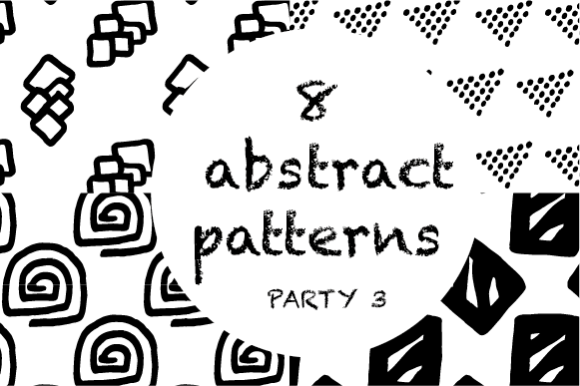
8 Abstract Patterns: Handmade Plant Motifs That Elevate Real Projects
Eight Abstract Patterns isn’t just a collection—it’s a curated set of 400×400 mm plant-inspired motifs, designed by hand and delivered in editable AI (Adobe Illustrator) files. Each pattern balances organic flow with intentional abstraction—think subtle leaf veins, rhythmic stem curves, and layered botanical silhouettes that avoid cliché while remaining instantly recognizable as nature-rooted. Designers, educators, small business owners, and crafters use them for branding, textile mockups, packaging prototypes, classroom visuals, and even laser-cut wall art. What makes them especially useful? They’re built to scale cleanly, layer without visual conflict, and adapt across media—from screen to print to embroidery.
Assuming “Abstract” Means “Generic”—and Losing Visual Impact
Some users download 8 Abstract Patterns expecting minimalism-by-default—flat shapes, low contrast, or overly simplified forms—and are surprised when the motifs feel rich, textured, and subtly dimensional. That’s intentional. These aren’t clipart; they’re crafted abstractions rooted in real plant morphology. Mistaking abstraction for emptiness leads to poor pairing choices—like overlaying a delicate fern motif over busy photography or using a high-contrast vine pattern on a dark background without checking luminance values first.
A better approach? Preview each motif at actual size (400×400 mm) in your layout software *before* finalizing color or placement. Try toggling layers on/off in the AI file to see how individual elements interact. One freelance stationery designer discovered her “soft green leaf” pattern had fine-line detailing that vanished when printed at 72 dpi—she switched to vector-only export and adjusted stroke weights manually. That small check saved two rounds of proofing.
Overlooking File Structure—and Wasting Time Editing
The 8 Abstract Patterns pack includes eight separate AI files—not one multi-layered master. That’s deliberate: it gives you precise control per motif, avoids accidental cross-editing, and keeps file sizes manageable. Yet some users open all eight at once, group them into a single document, and then struggle with inconsistent layer naming, misaligned artboards, or unintended compound paths.
Before editing, verify which version of Illustrator you’re using. Files are saved in AI v8 format for broad compatibility—but if you’re on Illustrator CC 2023+, you’ll gain access to global colors and repeat grids that weren’t available in earlier versions. Don’t force legacy workflows. Instead, open one file at a time, rename layers meaningfully (e.g., “Main Stem,” “Secondary Veins”), and save variants with descriptive suffixes like “_for-embroidery” or “_web-optimized.” It takes two minutes upfront and prevents confusion later.
Ignoring Scale Context—and Misjudging Real-World Use
At 400×400 mm, these patterns tile seamlessly—but only if applied with intention. A common oversight is testing them solely on-screen at thumbnail size, then applying them full-scale to a tote bag or wall mural without checking rhythm or density. One educator ordered custom-printed fabric for student art kits, assuming the “dandelion puff” motif would read clearly at 1.5 meters wide. In reality, the fine seed lines blurred beyond 1 meter. She reprinted at 60% scale and added a subtle outer stroke—simple fixes that preserved clarity.
Ask yourself: Where will this live? On a 1200×800 px blog header? A 36″×48″ poster? A 2″×2″ enamel pin? Adjust accordingly. Zoom out to 25% in Illustrator and scroll slowly—you’ll spot spacing imbalances or visual “hot spots” faster than at 100%.
Treating All Eight as Equal Substitutes—Not Complementary Tools
These aren’t interchangeable swatches. Pattern #3 (a looping ivy variant) works beautifully for borders and frames. Pattern #6 (a radial seedpod arrangement) anchors center-focused layouts like book covers or app icons. Pattern #1 (a staggered monstera rhythm) excels in vertical repeats—think wallpaper or website sidebars. Using #6 where #3 is needed creates visual tension; using #1 horizontally without adjusting spacing causes awkward gaps.
Test pairings early. Drop two motifs into the same artboard at 50% opacity. Do they harmonize—or compete? Does one visually “pull” more weight? If so, adjust saturation, stroke width, or add a neutral buffer shape between them. A small-business owner selling ceramic mugs used Pattern #2 (a soft frond cascade) for product labels and Pattern #5 (a tight bud cluster) for social media avatars—same botanical language, different roles.
Skipping Color Mode Checks—Then Facing Print Surprises
All 8 Abstract Patterns files are built in CMYK by default—ideal for professional printing—but many users edit in RGB, assume colors will translate, and end up with muted greens or dull ochres on physical goods. The discrepancy isn’t a flaw in the files; it’s an expectation mismatch.
If your end use is digital-only (websites, presentations, social posts), convert to RGB *after* finalizing shapes and strokes—not before. For mixed-use projects, keep two versions: one CMYK master for print vendors, one RGB derivative for screens. Name them clearly. And always soft-proof in Illustrator using your printer’s ICC profile if available.
Underestimating Licensing Scope—Then Hesitating to Use Freely
These motifs come with an extended commercial license: you can use them in client work, sell products featuring them (like notebooks or apparel), and even incorporate them into SaaS dashboards or e-learning modules—no attribution required. Yet some freelancers hold back, assuming restrictions apply because the files are “handmade” or “abstract.”
Read the license terms once—not just the headline. You’ll see clear allowances for modification, resale, and redistribution *within finished products*. What’s not allowed? Reselling the AI files themselves or offering them as standalone design assets. That boundary protects both you and the creator. When in doubt, ask—not assume.
Final Check Before Download or Deployment
Before downloading or applying any of the 8 Abstract Patterns, ask three questions:
- Is the motif’s visual weight appropriate for my medium? (e.g., fine details need higher DPI or larger scale for print)
- Does its rhythm support—not distract from—my message or function? (e.g., a chaotic vine pattern undermines readability in body text areas)
- Have I verified color mode, artboard size, and layer structure for my specific workflow?
These patterns thrive when treated as thoughtful tools—not decorative afterthoughts. They reward attention to context, respect for craft, and willingness to test before committing. Whether you’re designing a yoga studio’s seasonal menu, prototyping a sustainable skincare label, or illustrating a children’s science unit, these handmade plant motifs offer grounded elegance without sacrificing flexibility. Start small: pick one pattern, place it intentionally, adjust mindfully, and build from there.