Meadowland Floral Seamless Digital Papers
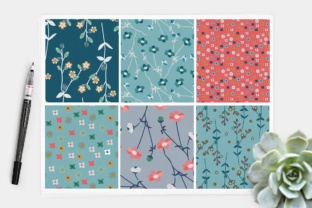
Imagine opening a digital folder and finding six hand-drawn prairie flower patterns—each one 12×12 inches at 300 dpi, fully seamless, ready to tile across any surface without visible edges or repeats. That’s what Meadowland Floral Seamless Digital Papers - Prairie Flowers Patterns delivers: a cohesive, nature-inspired collection where wild roses, Queen Anne’s lace, yarrow, and native grasses flow together with quiet intention—not stiff symmetry, but gentle rhythm.
Why “seamless” matters more than you might think
A seamless pattern isn’t just a technical detail—it’s the difference between a background that feels handmade and one that looks accidentally stitched together. These JPEGs tile cleanly in design software like Canva, Photoshop, Affinity Designer, or even PowerPoint. No clipping masks needed. No awkward gaps when scaled for a full-page blog header or an A4 invitation. For someone building their first printable planner, that reliability saves hours of trial and error. For a freelance designer juggling three client deadlines, it means dropping a pattern into a layout and moving on—without second-guessing alignment or resolution.
What creators actually do with these papers
It’s not about what the files *are*. It’s about what they *unlock*.
- Stationery makers use them as textured backdrops behind foil-stamped names on wedding invites—or as subtle liners inside thank-you cards. One small business owner told us she layered a lighter version over kraft paper stock in her mockups, giving clients a realistic sense of how the final printed piece would feel: soft, grounded, unhurried.
- Educators and homeschoolers print them onto cardstock to create tactile sorting mats for botany units—or turn them into laminated classroom posters showing native prairie plants. The botanical accuracy (even in stylized form) supports learning without sacrificing visual warmth.
- Bloggers and content creators apply them as section dividers, newsletter headers, or Pinterest pin backgrounds. Because the patterns are light enough in contrast, text remains highly legible—even over floral clusters—so readability stays intact without extra masking or opacity tweaks.
- Digital scrapbookers layer them under photo clusters, use them as page bases, or slice sections to frame journaling spots. Their organic flow complements candid, lifestyle-focused layouts better than rigid geometrics ever could.
Beginners vs. experienced users: different needs, same files
If you’re just learning Canva or starting your first Etsy shop, your priority is simplicity. You want something that works straight out of the download—no vector conversions, no color mode confusion, no need to understand CMYK vs. RGB. These JPEGs meet that need: open, drag, resize, export. Done. No tutorials required.
More experienced designers may look deeper: How does the pattern hold up when enlarged for a large-format poster? Does the hand-drawn texture retain its charm at 200% scale? (It does—the linework stays crisp, and the subtle variations in stroke weight add character instead of noise.) Is there enough visual breathing room to overlay typography without crowding? (Yes—the compositions balance density and openness intentionally.)
That said, if you work heavily with scalable assets—like creating brand kits or designing SVG cut files—you’ll notice these are JPEGs, not vectors. That’s intentional: they’re optimized for texture, depth, and print-ready fidelity—not infinite scaling. If you need vectors, the note about contacting the creator is there for a reason: it’s an invitation to ask, not a limitation to work around.
Practical questions you might have—and what they really mean
“Are these commercial use?” — Yes, for physical and digital products you sell (invitations, planners, social templates), as long as you don’t resell the patterns themselves as standalone assets. That clarity helps small business owners avoid licensing guesswork.
“Will they print well?” — At 300 dpi and 12×12 inches, they’re built for high-resolution output. Test prints on matte cardstock show delicate petal edges and fine stem lines clearly—no pixelation, no blurring. That matters whether you're printing 10 copies for a baby shower or 500 for a boutique stationery line.
“Can I recolor them?” — Easily, in any raster editor. Because they’re flat JPEGs (not layered PSDs), you’ll use adjustment layers or hue/saturation tools—but that also means smaller file sizes and faster loading times, especially on older machines or tablets.
When this set fits—and when it might not
This collection shines in projects where warmth, authenticity, and botanical storytelling matter. Think: wedding brands with earthy palettes, educators teaching ecosystem literacy, bloggers documenting slow-living routines, or crafters making heirloom-style journals.
It’s less ideal if your work relies on bold graphic contrast, ultra-minimalist grids, or photorealistic textures. These aren’t hyper-detailed botanical illustrations—they’re expressive, cohesive, and designed to support, not dominate.
And while six patterns may sound limited, they’re curated to complement—not compete. One has airy stems and scattered blooms; another clusters blossoms densely along a horizon line; a third uses monochrome ink-wash tones for versatility. Together, they give variety without visual fatigue.
A note on longevity and creative value
Digital papers like these don’t expire. They don’t require subscriptions. Once downloaded, they’re yours—no cloud sync, no login, no version updates to track. That makes them especially useful for educators building offline lesson banks, freelancers archiving past client work, or hobbyists who return to a favorite project months later and still find the same files working exactly as remembered.
They also invite play. Try flipping one horizontally before tiling it. Overlay two at 15% opacity. Print one on vellum and layer it over watercolor paper scans. The hand-drawn origin means imperfections are part of the charm—not bugs to fix, but qualities to lean into.
If you’ve ever hesitated to start a design project because the background felt “off,” or spent too long adjusting repeat settings just to get a clean edge—this set removes that friction. Not by doing the work for you, but by offering materials that behave predictably, look thoughtfully crafted, and leave space for your voice to come through.