Retro Inspired Vector Patterns: From Forgotten Floor Tiles to Modern Design Tools
It all started when I saw my office kitchen’s floor.
A few months ago, my colleague and I moved into a small downtown office—a modest space tucked inside a weathered brick building in one of the oldest districts of our city. The structure itself felt like a living archive: before us, it housed a design laboratory; before that, a dentist’s suite; earlier still, a psychotherapist’s quiet waiting room; and decades prior, a law firm whose brass nameplate still faintly glinted beneath layers of paint near the stairwell. No one knew what occupied the space before the 1920s—but that mystery only deepened the sense of discovery.
What captivated me immediately wasn’t the history alone, but the visual language embedded in the architecture: hand-laid terrazzo floors with geometric medallions, ceiling borders traced in Art Deco motifs, elevator doors etched with sunburst patterns, and even the subtle linoleum remnants in storage closets—faded but unmistakably mid-century. These weren’t just decorative choices. They were intentional, culturally resonant, technically precise expressions of their time—crafted not for algorithms or trend cycles, but for human rhythm, light, and longevity.
How Observation Becomes Design Resource
We didn’t set out to build a pattern library. We began by paying attention—by slowing down enough to notice repetition, symmetry, scale shifts, and material constraints. My colleague brought a background in archival research; I contributed vector illustration and digital texture development. Together, we treated the building as both muse and field site.
Each morning, before emails piled up, we’d walk the corridors with cameras, sketchbooks, and calipers. We documented not just what patterns looked like—but how they aged: where grout lines softened edges, where foot traffic wore down contrast, where humidity subtly altered color saturation over decades. We scanned tiles, traced stencils from peeling wallpaper fragments, and even borrowed archival blueprints from the city planning department to cross-reference original design specifications.
This grounded, tactile process reshaped how we think about Retro Inspired Vector Patterns. They’re not nostalgic pastiches. They’re distillations—abstractions rooted in real-world constraints, cultural syntax, and analog craftsmanship. A 1960s textile repeat wasn’t designed in isolation; it responded to loom widths, dye absorption rates, and retail display conventions. A 1970s wallpaper motif balanced optical vibration with domestic comfort. Understanding those contexts lets us translate them meaningfully—not replicate them superficially.
Why Seamless Matters—Beyond Aesthetics
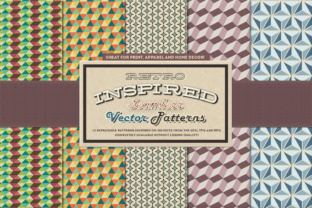
The first pack of 15 Retro Inspired Vector Patterns reflects that intentionality. Each is fully seamless, mathematically aligned, and built in scalable vector format (SVG and AI), ensuring crisp rendering at any size—from social media banners to billboard murals. But seamlessness here isn’t just technical convenience—it’s conceptual continuity.
Consider Pattern #7 (“Coral Grid”), inspired by a cracked linoleum tile near the building’s service entrance. Its interlocking hexagons echo cellular structures and honeycomb logic, but its spacing and stroke weight were calibrated to mimic how ink bled slightly on vintage screen prints. When tiled, the slight irregularity in node alignment creates gentle visual rhythm—not mechanical monotony. That nuance matters for designers working on branding systems where repetition must feel intentional, not automated.
Likewise, Pattern #12 (“Sunset Tracer”) draws from a deteriorated ceramic border in the former dentist’s waiting room. Its concentric arcs reference 1950s atomic-age optimism, yet its gradient transitions are modeled after how cobalt oxide pigments fade unevenly under fluorescent light over 40 years. In vector form, that behavior is encoded—not as a static gradient, but as layered, editable stops that allow users to adjust warmth, contrast, or direction without breaking the retro syntax.
Practical Applications Across Disciplines
Retro Inspired Vector Patterns serve far more than decorative roles. Their value emerges most clearly in use cases where authenticity, scalability, and contextual resonance intersect.
- Brand Identity Systems: A sustainable fashion label used Pattern #3 (“Olive Weave”)—based on a wool upholstery swatch found in the shrink’s old consultation room—as the underlying texture for packaging foil stamping. Because the vector file retained editable stroke profiles, they adjusted line weight to match embossing depth, ensuring tactile fidelity across paper, fabric tags, and web assets.
- Educational Materials: A university art history department licensed the full set to illustrate lectures on postwar design philosophy. Instructors isolated individual motifs to demonstrate how modular systems enabled mass production while preserving artisanal variation—a concept difficult to convey with JPEGs alone.
- UI/UX Design: A fintech startup integrated Pattern #9 (“Circuit Loop”)—inspired by copper wiring diagrams stenciled onto basement conduit covers—into subtle background elements of their dashboard. Its low-contrast, high-frequency geometry provides visual grounding without competing with data visualization, satisfying accessibility contrast ratios while reinforcing their “human-centered tech” narrative.
- Architectural Visualization: Interior architects testing material palettes for historic renovation projects applied these patterns directly onto 3D model surfaces. Unlike raster textures, the vectors scaled perfectly across curved walls and irregular ceilings, maintaining edge clarity during real-time walkthroughs.
What Makes These Patterns Distinct from Generic “Retro” Assets?
Most commercially available retro patterns prioritize surface resemblance: bold colors, obvious shapes, dated fonts. These Retro Inspired Vector Patterns emphasize structural intelligence—the grammar behind the style.
For example, many 1960s repeats relied on rotational symmetry rather than mirror reflection because rotary printing presses made rotation mechanically efficient. Our Pattern #5 (“Marigold Spin”) replicates that constraint—not as a limitation, but as a generative rule. Rotating the base unit 60° produces perfect alignment every time, enabling dynamic layout options impossible with mirrored repeats.
Similarly, 1970s wallpaper often used “drop repeats” to minimize visible seams across wide rolls. Pattern #14 (“Amber Drop”) encodes that vertical offset precisely—so when applied to a 2-meter-high wall mockup, the shift aligns with standard roll widths (53 cm), reducing digital waste and improving print accuracy.
This attention to period-specific production logic transforms each pattern from decoration into a design partner—one that informs decisions, not just decorates outcomes.
Integrating Retro Inspired Vector Patterns Thoughtfully
Adoption doesn’t require stylistic commitment to a single era. Because these patterns were extracted from layered, overlapping histories, they’re designed to coexist. A 1960s-inspired dot matrix can sit comfortably beside a 1940s-inspired damask when both share consistent stroke logic, proportional hierarchy, and neutral base tones.
Start by auditing your existing assets: What’s the dominant rhythm in your typography? Is your color palette high-contrast or muted? Does your interface favor sharp corners or soft transitions? Match pattern density and scale to those qualities—not to calendar decades. A delicate “Bauhaus Lattice” (Pattern #2) may support minimalist SaaS dashboards more effectively than a loud “Disco Burst” (Pattern #11)—even though both are retro-inspired.
Also consider output context. For laser-cut signage, simplify anchor points using path optimization tools—retaining shape integrity while reducing machining time. For embroidery digitizing, convert strokes to stitchable paths with appropriate underlay logic. The vector foundation makes these adaptations possible without sacrificing stylistic coherence.
Looking Ahead: Beyond Nostalgia, Toward Continuity
This first collection of 15 Retro Inspired Vector Patterns is neither exhaustive nor definitive. It’s a calibration point—a way to test assumptions, invite critique, and observe how practitioners reinterpret historical forms in contemporary workflows.
We’re already documenting second-layer inspirations: the rubber-stamped letterheads from the law office’s filing cabinets, the hand-drawn schematics taped to HVAC access panels, the chalk outlines left by contractors during the dentist’s 1980s remodel. Each reveals another facet of how design lives in infrastructure—not just galleries or catalogs.
What endures isn’t the look of a particular decade, but the principles beneath it: clarity of purpose, respect for material behavior, responsiveness to human scale, and generosity toward future adaptation. When you choose a Retro Inspired Vector Pattern, you’re not selecting a style. You’re engaging with a lineage—one that stretches from hand-carved woodblocks to today’s parametric modeling tools, united by the same quiet question: *How can repetition carry meaning, not just coverage?*