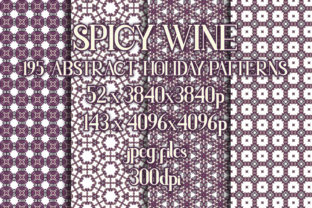
Spicy Wine – Subtle Holiday Patterns
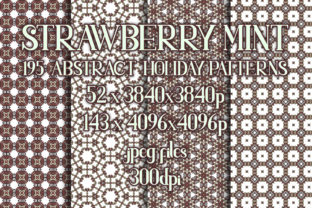
If you’ve ever scrolled through a design resource library and paused—not because something screamed for attention, but because it quietly *settled* into your peripheral vision with warmth, rhythm, and quiet intention—you know the kind of presence Spicy Wine – Subtle Holiday Patterns carries. This isn’t bold festive graphics or glittering vector ornaments. It’s a curated collection of 195 high-resolution decorative prints: soft botanical motifs, faint geometric echoes, delicate snow-dusted branches, and abstracted winter textures—all rendered in that rich, nuanced tone of spicy wine: deep burgundy, warm plum, muted cranberry, and earthy rose. Each pattern breathes space. None overwhelm. All invite closer looking.
A Texture-First Mindset for Modern Design
These aren’t “holiday backgrounds” in the traditional sense—they’re textural foundations. At 3840 × 3840 px and 4096 × 4096 px (300 dpi), they scale beautifully from social media banners to luxury product packaging, editorial spreads, or custom stationery. The subtle repetition—never rigid, always organic—creates visual continuity without monotony. You’ll notice how a single motif might appear three times across a tile, each iteration slightly softened or repositioned, mimicking natural variation. That’s intentional craftsmanship, not algorithmic replication.
Because they’re JPEGs—not vectors or layered PSDs—they behave predictably across platforms and software. No font embedding issues. No missing layers. Just clean, ready-to-place assets. File sizes range thoughtfully between 2–21 MB: large enough to retain fine grain and tonal gradation, small enough to keep workflows nimble. The archive itself is lean (1.6 GB compressed, 1.9 GB unpacked), meaning you can download, extract, and start testing within minutes—not hours.
Where These Patterns Earn Their Keep
Spicy Wine – Subtle Holiday Patterns thrives where restraint communicates sophistication. Think: a boutique candle brand launching a limited-edition winter line—the patterns wrap around matte kraft boxes, whispering seasonality without shouting it. Or a wellness newsletter using one as a background for a subscriber-only holiday reflection piece—its warmth supports the message without competing with body text. A wedding planner might layer a faint version behind elegant serif headlines on a digital invitation suite, letting the typography lead while the texture adds emotional resonance.
They’re especially effective in editorial design and branding systems that value consistency over novelty. Unlike trend-driven graphics that feel dated by January, these patterns rely on timeless color psychology and tactile familiarity—deep reds associated with warmth and celebration, soft edges that suggest approachability, and low-contrast variations that ensure accessibility. They don’t dominate; they support. And that makes them unusually versatile across both print and digital contexts.
Real-World Pairing Principles
Don’t default to pairing these with ornate scripts or heavy display fonts. Instead, try contrast: set crisp, neutral sans serifs (think Inter, Poppins, or even a refined Helvetica Neue) over a softly tiled pattern. The clarity of the typeface holds its ground against the texture’s gentle complexity. For print projects like greeting cards or gift tags, experiment with letterpress-style serif fonts (e.g., Adobe Garamond or Sorts Mill Goudy)—their slight ink spread harmonizes naturally with the organic grain in the patterns.
One practical tip: preview at actual size. Zoom out to 25% in your layout tool. Does the pattern still read as cohesive—not noisy or muddy? If it dissolves into visual static, reduce opacity (10–15%) or apply a subtle Gaussian blur (0.3–0.6 px). These adjustments preserve mood without sacrificing legibility.
Licensing That Aligns With How You Actually Work
The archive includes full commercial usage rights—no restrictions on client work, merchandise, or digital products—as long as the source image remains uncredited (it’s a manipulated Pixabay base, so attribution isn’t required). That means if you’re a freelance designer building a Shopify theme for a seasonal boutique, or a blogger creating printable holiday planners, or a craft supplier designing labels for handmade preserves—you’re covered. There’s no need to track usage caps, renew subscriptions, or worry about platform-specific limitations.
What’s not included—and this matters—is editable vector versions or layered source files. These are final, optimized JPEGs. So if your project demands precise color replacement (e.g., swapping every burgundy tone for navy), plan ahead: use adjustment layers in Photoshop or apply CSS filters in web builds. But for 90% of real-world applications—backgrounds, overlays, texture fills, subtle borders—these deliver exactly what’s needed, with zero overhead.
When to Reach for Spicy Wine — and When Not To
Reach for Spicy Wine – Subtle Holiday Patterns when your goal is atmospheric cohesion, not focal-point decoration. It shines in projects where the audience values calm, intention, and quiet elegance—think mindfulness apps, artisan food brands, literary journals, or heritage retailers updating their seasonal campaigns.
It’s less ideal when you need high-contrast, scalable icons; ultra-minimalist layouts demanding absolute visual silence; or fast-turnaround social posts requiring instant recognition. In those cases, simpler, bolder assets often serve better. But for anything where “feeling” matters as much as function—where warmth, tactility, and understated celebration are part of the brief—this collection earns its place in your working toolkit.
One last note: test early, test often. Drop a pattern into your actual layout—not just a blank canvas. See how it interacts with your brand’s primary colors, how it behaves behind live text blocks, how it renders on mobile screens. These patterns reward thoughtful integration, not drop-in deployment. That’s why designers who return to them again and again treat them like pigments: mixing, diluting, layering—not just applying.