Winter Holiday Patterns: Christmas Mood — Warmth, Whimsy, and Design Versatility
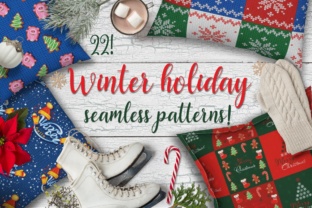
Winter Holiday Patterns: Christmas Mood is a curated digital design resource built around emotional resonance and tactile authenticity. Unlike generic holiday collections that prioritize scale over sentiment, this set centers on a specific atmospheric quality — cozy joy — expressed through hand-crafted visual motifs: soft knitted textures, warmly lit gingerbread arrangements, and playful animal-shaped cookies. Its 22 seamless patterns (5000 × 5000 px, 300 dpi) are delivered in both JPEG and EPS 10 formats, making them suitable for high-resolution print applications as well as scalable vector-based editing.
What Sets “Christmas Mood” Apart From Other Holiday Pattern Collections
Many winter-themed pattern libraries emphasize either maximalist festivity (think bold red-and-gold geometrics or dense snowflake repeats) or minimalist Scandinavian restraint (thin-line motifs, monochrome palettes). Winter Holiday Patterns: Christmas Mood occupies a deliberate middle ground — one rooted in sensory familiarity. The knitted backgrounds aren’t just decorative; they evoke the physical comfort of wool throws, steaming mugs, and quiet afternoons. The gingerbread cookies placed atop those textures aren’t isolated icons — they’re integrated into the rhythm of the repeat, suggesting narrative continuity rather than static decoration.
This attention to mood-driven composition makes it especially effective for projects where emotional tone matters as much as visual function — greeting cards with handwritten notes, boutique packaging for artisanal confections, or editorial layouts in lifestyle magazines covering seasonal wellness or slow living. It’s less about “holiday branding” in the corporate sense and more about supporting storytelling grounded in warmth and gentle humor.
How Format Choices Influence Practical Use
The inclusion of both JPEG and EPS 10 files addresses real-world workflow needs. JPEGs offer immediate usability — drag-and-drop compatibility across most design tools, fast rendering in web mockups, and predictable color behavior in CMYK prepress environments. EPS 10 ensures backward compatibility with older versions of Adobe Illustrator and supports non-destructive scaling without pixelation — valuable when adapting patterns for large-format prints like wrapping paper rolls or fabric yardage.
That said, users working exclusively in modern vector-first pipelines (e.g., Figma with SVG plugins or Affinity Designer) may find the EPS format less flexible than native SVG exports. Similarly, designers needing transparency for layered digital composites will need to work with the JPEGs in RGB mode and manually mask edges — the files don’t include alpha channels. These aren’t flaws, but practical tradeoffs worth noting when evaluating fit against your specific output requirements.
Comparing Visual Tone With Alternative Approaches
Consider three common alternatives:
- Traditional folk-inspired patterns — Often feature intricate linocut-style motifs, regional symbolism (e.g., Swedish Dala horses, Ukrainian pysanky), and historically accurate color palettes. They excel in cultural authenticity but may feel overly formal or regionally specific for broader commercial use.
- Contemporary abstract holiday patterns — Prioritize clean lines, gradient overlays, and asymmetrical balance. Ideal for tech brands launching seasonal campaigns or modern retailers seeking freshness — but risk feeling emotionally distant from classic holiday associations.
- Photographic texture packs — Provide realism and depth (e.g., actual knitted swatches shot on white), yet lack seamless tiling out-of-the-box and require manual blending to avoid visible seams at scale.
Winter Holiday Patterns: Christmas Mood bridges these categories: it’s stylized enough for brand consistency, textured enough for tactile credibility, and cohesive enough to maintain visual harmony across multiple touchpoints — from social media banners to gift tag die-cuts.
When This Collection Fits Best — And When It Might Not
This set shines in contexts where audience connection hinges on relatability and gentle nostalgia. A small-batch bakery designing labels for spiced shortbread? The gingerbread-on-knits motif reinforces product craftsmanship and homemade charm. An indie stationery brand launching a holiday card line? The warm palette and organic repeats support handwritten typography and soft photography without competing for attention. Even interior designers sourcing wallpaper concepts for cozy reading nooks have used individual patterns as mood board anchors — not just as final assets, but as tonal references.
Conversely, Winter Holiday Patterns: Christmas Mood may be less suited for applications demanding strong contrast, sharp legibility at small sizes, or thematic neutrality. For example:
- A national retail chain updating in-store signage needs bold, scalable iconography — not subtle textile gradients.
- A children’s book illustrator seeking dynamic action poses would likely supplement, not rely on, the cookie-based motifs, which lean toward still-life arrangement over narrative motion.
- Brands observing multiple winter holidays (e.g., Hanukkah, Kwanzaa, Yule) may find the Christmas-specific cues too narrow without thoughtful adaptation — though the underlying warmth and handmade aesthetic can serve as adaptable foundations with careful layout and color adjustments.
Real-World Adaptation Examples
One user repurposed the “gingerbread on oat-toned knit” pattern as a background for an email newsletter header — reducing opacity to 15% and overlaying crisp white sans-serif type. The result felt festive but uncluttered, with the texture adding depth without sacrificing readability.
Another designer extracted a single pig-shaped cookie motif, converted it to vector using Image Trace, then recolored it in metallic gold for a New Year’s Eve invitation suite. Because the original was captured at high resolution and with consistent lighting, the traced version retained soft shadow detail that automated tools often lose.
A third team used four complementary patterns — two knitted bases and two cookie variations — to create a modular packaging system for a limited-edition hot chocolate kit. Each SKU had its own pattern, but shared the same warmth and scale, reinforcing product family cohesion without requiring custom illustration.
Evaluating Long-Term Value Beyond the Season
Digital pattern collections vary widely in reusability. Some become outdated quickly due to trend-dependent styling (e.g., heavy drop shadows, ultra-thin outlines). Winter Holiday Patterns: Christmas Mood avoids such pitfalls by anchoring its appeal in enduring sensory associations — wool, spice, sugar, quiet celebration. That gives it longer shelf life across years, not just seasons.
Still, longevity depends on how you integrate it. Using patterns as literal backgrounds limits flexibility. More experienced designers treat them as starting points: sampling base colors for custom palettes, isolating motifs for icon systems, or layering low-opacity repeats to build dimensional texture. The EPS files especially support this kind of iterative reuse — something harder to achieve with raster-only sets.
If your workflow involves frequent collaboration across platforms (e.g., handoff from Illustrator to Canva or Webflow), test one pattern in your target environment first. While the technical specs meet industry standards, rendering behavior can differ slightly depending on compression settings, color profiles, and preview modes.
Making Your Decision With Confidence
Choosing Winter Holiday Patterns: Christmas Mood isn’t about selecting “the best” holiday asset — it’s about matching expressive intent with executional fidelity. Ask yourself:
- Does my project benefit from evoking comfort and approachability more than spectacle or tradition?
- Do I need both high-res raster and editable vector versions for mixed-output needs?
- Will the warmth-focused palette align with existing brand colors — or require thoughtful contrast adjustments?
- Am I prepared to adapt motifs thoughtfully, rather than using them straight from the folder?
There’s no universal “right” answer — only what serves your goals, audience, and constraints most directly. Winter Holiday Patterns: Christmas Mood delivers distinctive atmosphere with professional-grade technical execution. Whether it’s the right choice depends less on its features in isolation, and more on how those features interact with your real-world design decisions.